Roswell Biotechnologies

Continuing on with my look at various sequencing companies. Today I decided to take a look at relative new-comer Roswell Biotechnologies.

Business

Roswell Biotechnologies was founded in July 2014. As of Jan 2018 they had about 15 employees and had raised about $6 million in funding from private investors according to Genomeweb [1]. I couldn’t find any SEC filings for the company (if someone can explain this, I’d be curious to better understand when SEC filings happen/don’t happen). The company is based in San Diego.

Technology

The Roswell approach is kind of interesting, it appears to be a tunnelling current detection approach. Other groups are investigating the use of nano gap systems employing direct detection or funcionalised tips (in the interests of full disclosure, I was previously CTO of a tunnelling current detection sequencing company). The Roswell approach however, is quite different.

Roswell still use a pair of electrodes to detect bases, but they build a somewhat more complex system to slowly feed a strand past the electrodes:
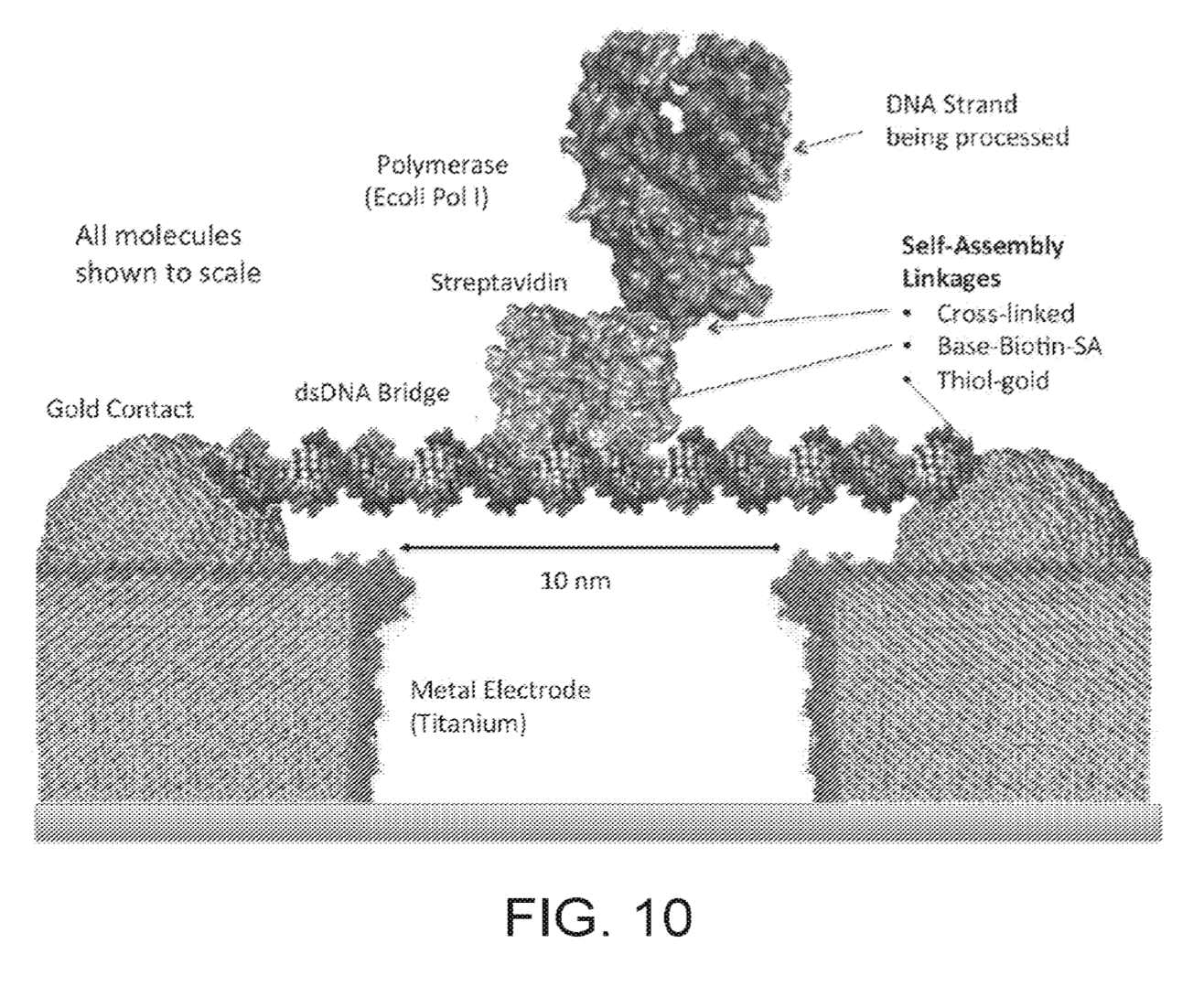
In the above schematic, a double stranded synthetic fragment of DNA is suspended between two gold contacts. This strand isn’t being read, it’s just a scaffold on to which a polymerase is mounted. A second, template strand second comes in (your sample) and is processed by the polymerase.

As bases are incorporated, they interfere with the tunnelling current between the electrodes. I guess the resulting current changes are possibly a combination of interference from the incorporation process itself and the double/single stranded DNA going past the electrode as it is processed by the polymerase. All that really matters is that each base gives a characteristic signal.

The patent [2] I’ve looked at shows real devices, and includes fabrication details. There are also additional patents which discuss methods of fabricating 18nm gold beads [3] these appear to be used to create gold contacts on which the synthetic DNA support is bound.
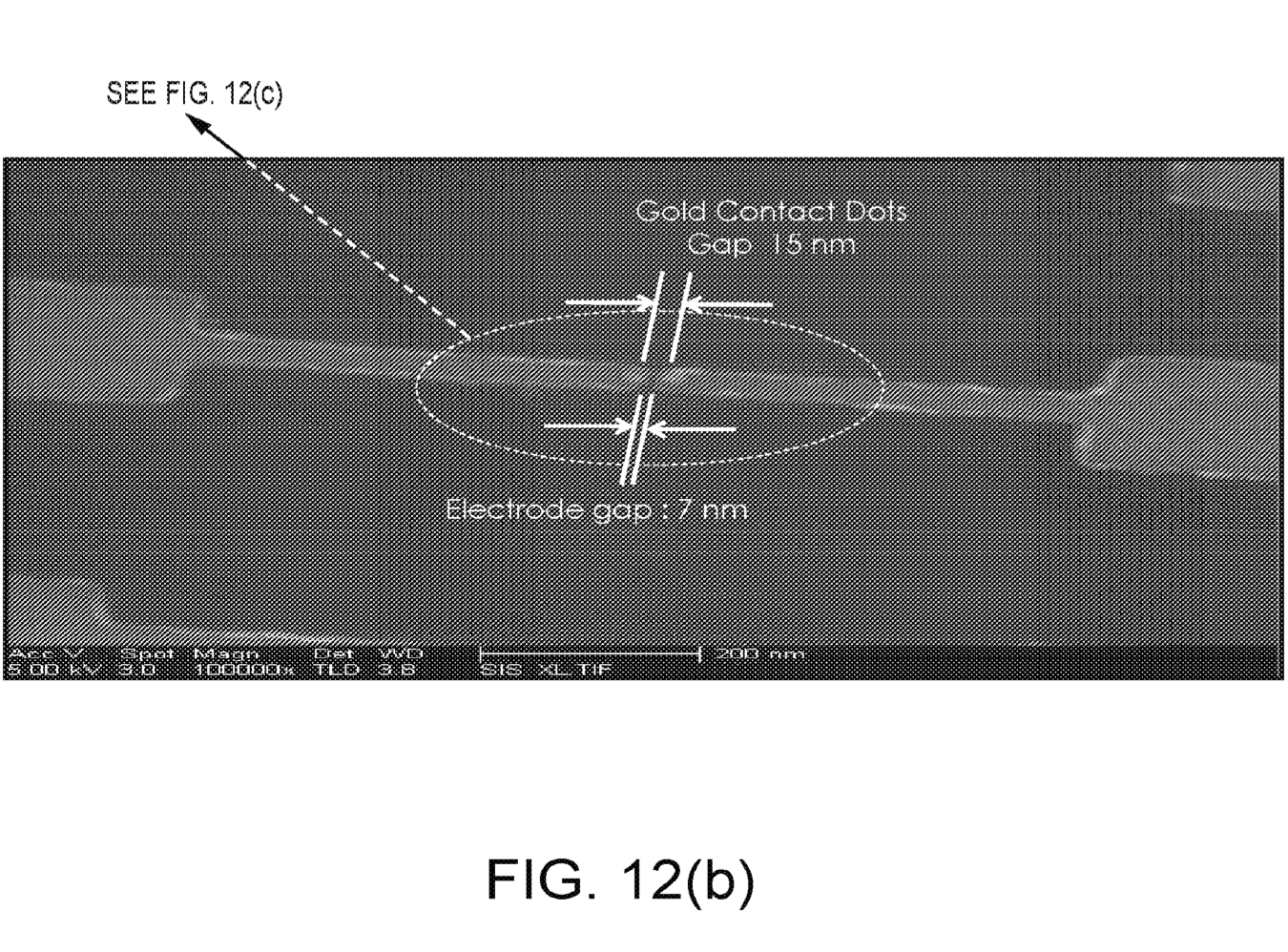
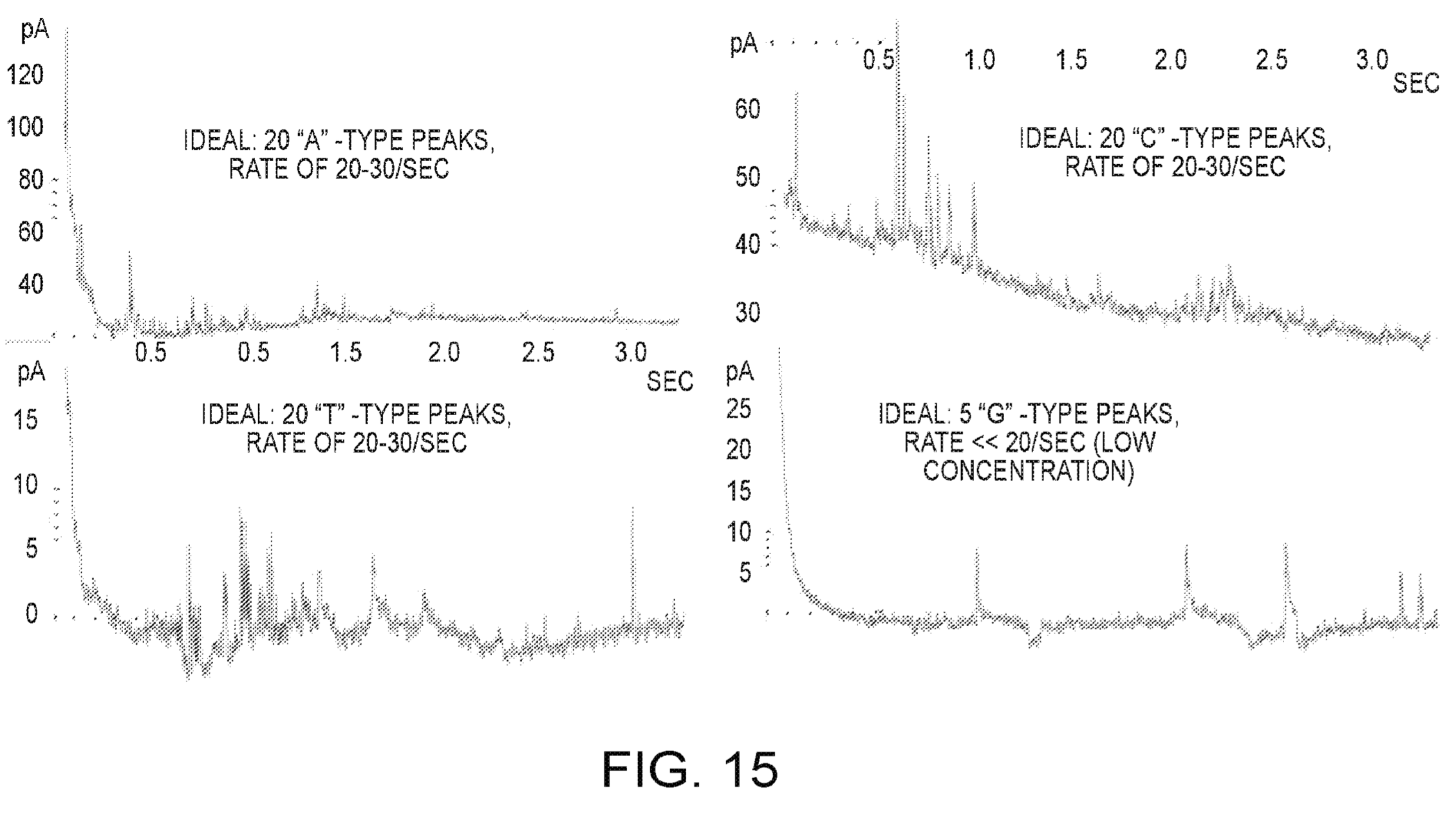
In addition to devices, they also show some data, this appears to be from long homopolymer runs (20 bases). Defections appear to be on the order of 60pA, they say that bases are processed at the rate of ~10 per second.

The graphs are slightly unclear to me, but as I understand it each peak is a single base. So between bases the current returns to baseline.
The approach seems very interesting, and I look forward to seeing more raw data. The genomeweb article says that they’re planning to enter early access testing by Q4 this year [1], and commercialise the system in 2019. So I’ll be keeping an eye out!

Notes

[1] https://www.genomeweb.com/sequencing/roswell-biotechnologies-harnesses-molecular-electronics-chip-based-dna-sequencing

“In Roswell’s approach, a single DNA polymerase is tethered to a molecule, for example a carbon nanotube or a piece of DNA, that is part of an electronic circuit. When the polymerase binds a DNA template and starts synthesizing DNA, the current flow through the circuit changes with each nucleotide incorporated, creating a signal that is base-specific and can also detect base modifications.

“We really have the polymerase wired into the circuit, and you are directly electrically monitoring what it does,” Merriman said. “This actually gives you a much more precise signal of what base is being incorporated than you get from nanopore-based approaches to interrogating DNA.”

The current levels are similar to those used in nanopore sequencing, on the order of picoamps, and the company has so far found no negative effect of the current on polymerase activity.”

“The plan is to have a system ready for testing by early-access users in the fourth quarter and to start commercializing the system in 2019.”

[2] http://www.freepatentsonline.com/WO2017132567A1.pdf

“sequencing genome compatible electrodes with a 5-20nm nano-gap there between, each pair of gapped electrodes having a pair of Au islands, which are for attaching immobilizing biomolecules, such as proteins or fragmented DNA, as bridges across the electrode pairs”

“Such electrode pairs are disclosed herein as usable within a device for genomie/DNA sequencing through electronic conductance measurements.”

“In this illustrated example the bridge biomolecule comprises a synthetic double stranded DNA molecule 20nm in length (60 bases) with thiol groups at both 5′ ends of the molecule for coupling to the Au contact points provided on the metal electrodes.” – Figure 10

With reference now to FIG. 15, the measuring of incorporation signals using the sensor is demonstrated. The plots in FIG. 15 show the current signals resulting from the sensor being supplied with various primed, single stranded DNA sequencing templates and dNTPs for incorporation and polymerization. In each case, the major signal spikes represent signals resulting from discrete incorporation events, wherein the polymerase enzyme adds another base to the extending strand. In the plot at the upper left, the template is 20 T bases. In the plot at the upper right, the template is 20 G bases. In the plot at the lower left, the template is 20 A bases. Lastly, in the plot at the lower right, the template is 20 C bases. The approximate rate of incorporation observed is about 10 to 20 bases per second, which is consistent with standard enzyme kinetics except for the lower rate of ~1 base per second presumed due to rate limiting factors (e.g., lower dNTP concentration).

[3] Fabrication of 18nm gold beads: https://patentimages.storage.googleapis.com/64/98/90/9ed2d36b40e4dc/US20170240962A1.pdf
InSilixa

This post reviews inSilixa, it’s a follow on from my list of sequencing companies. As we’ll see inSilixa isn’t really focused on sequencing, but it’s an interesting company anyway.

Business

inSilixa was founded in 2012, according to Crunchbase they’ve raised 13MUSD from PointGuard Ventures and Morningside Group. They appear to have received 2 SBIR grants totalling ~2MUSD. The company is based in Sunnyvale.

Technology

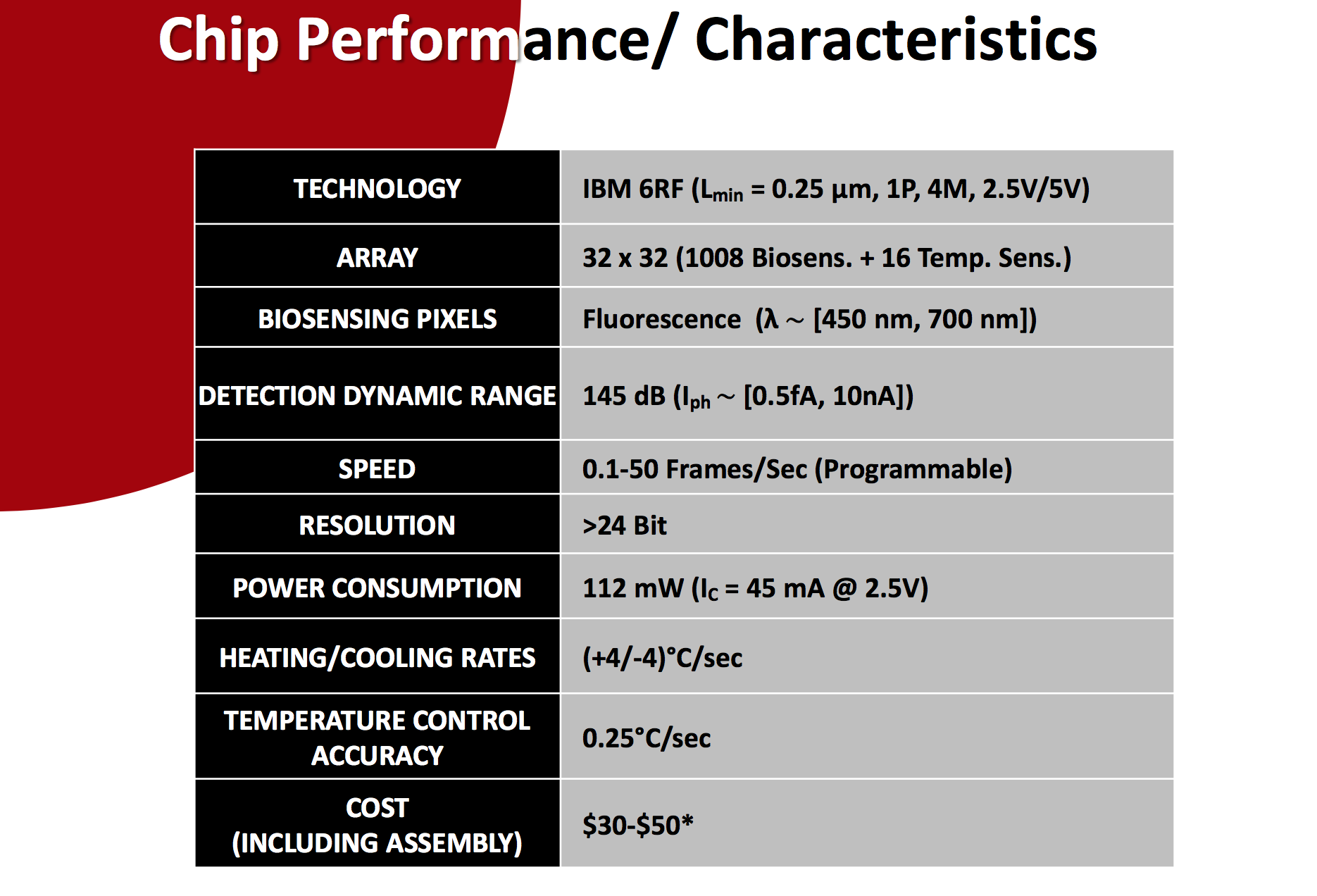
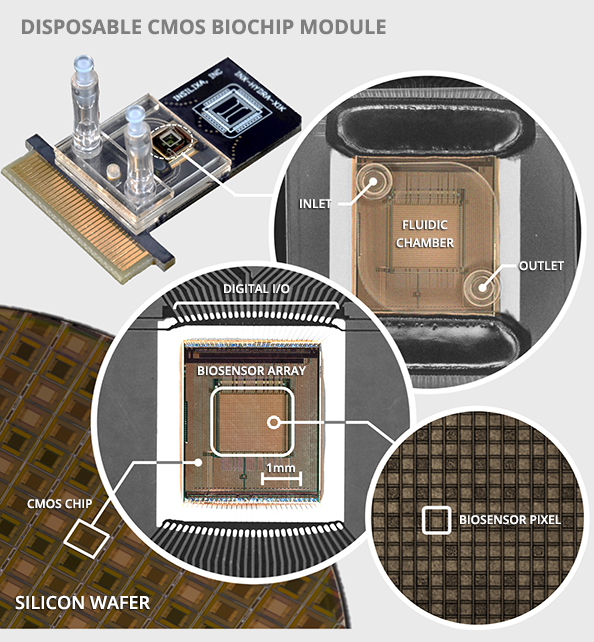
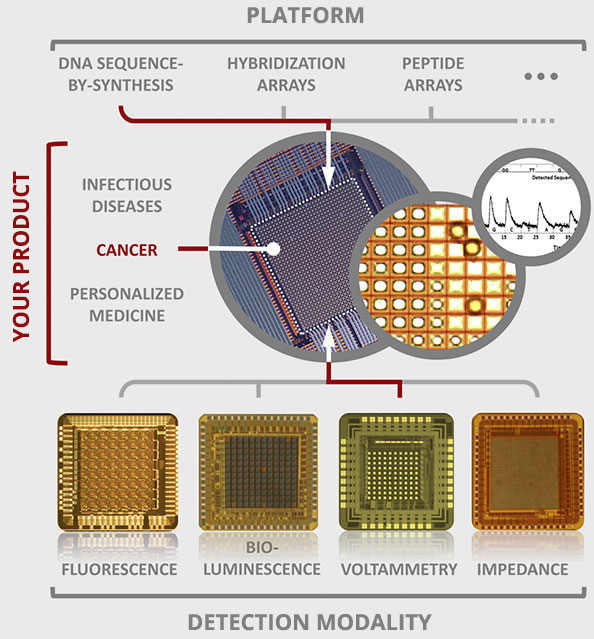
inSilixa appear to have a number of devices under develop, however their main focus seems to be a 1008 probe, hybridisation probe chip (other applications have been suggested, including sequencing by synthesis). The best source for most of this is a 2014 Hotchips presentation [4].

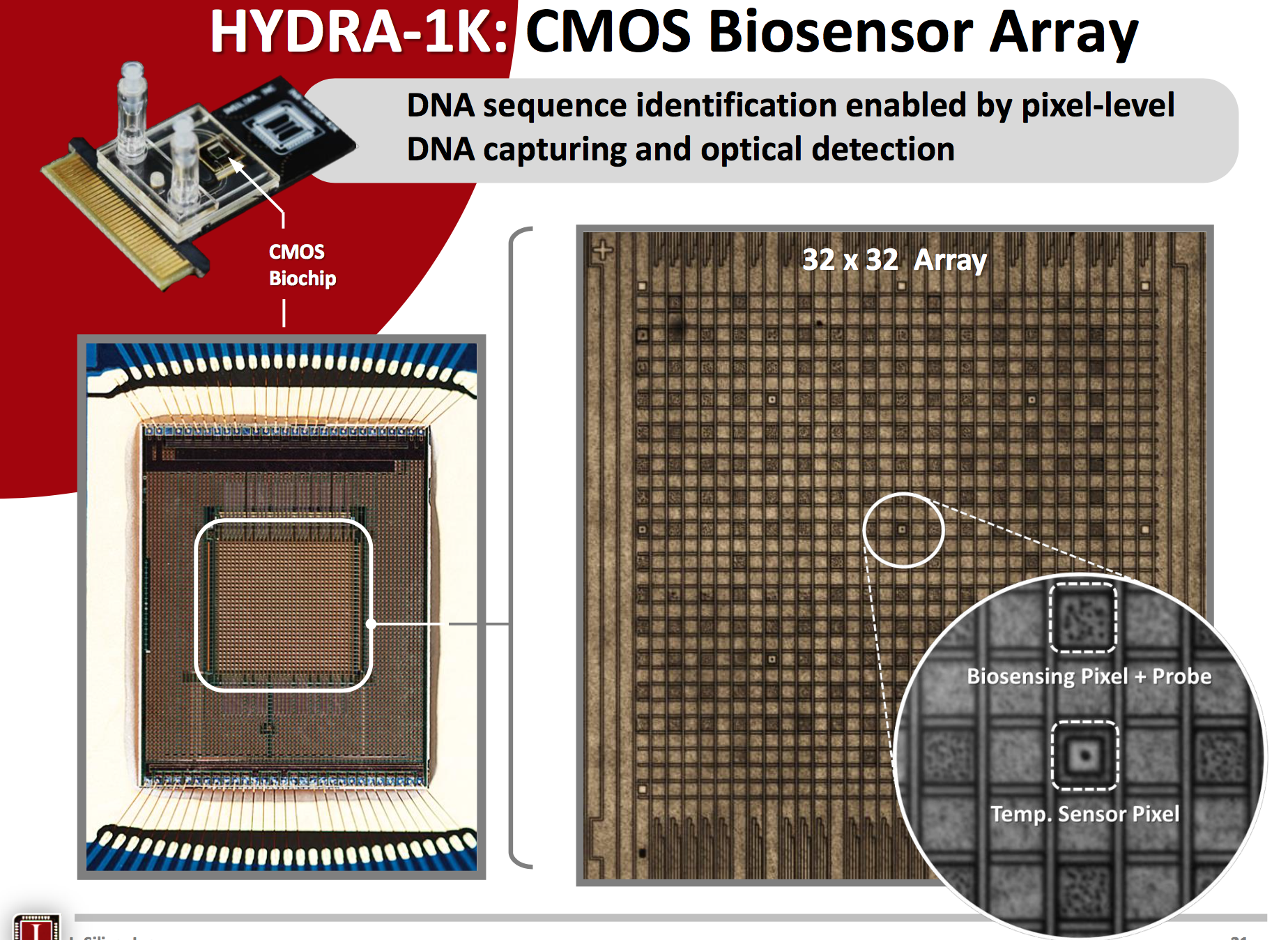
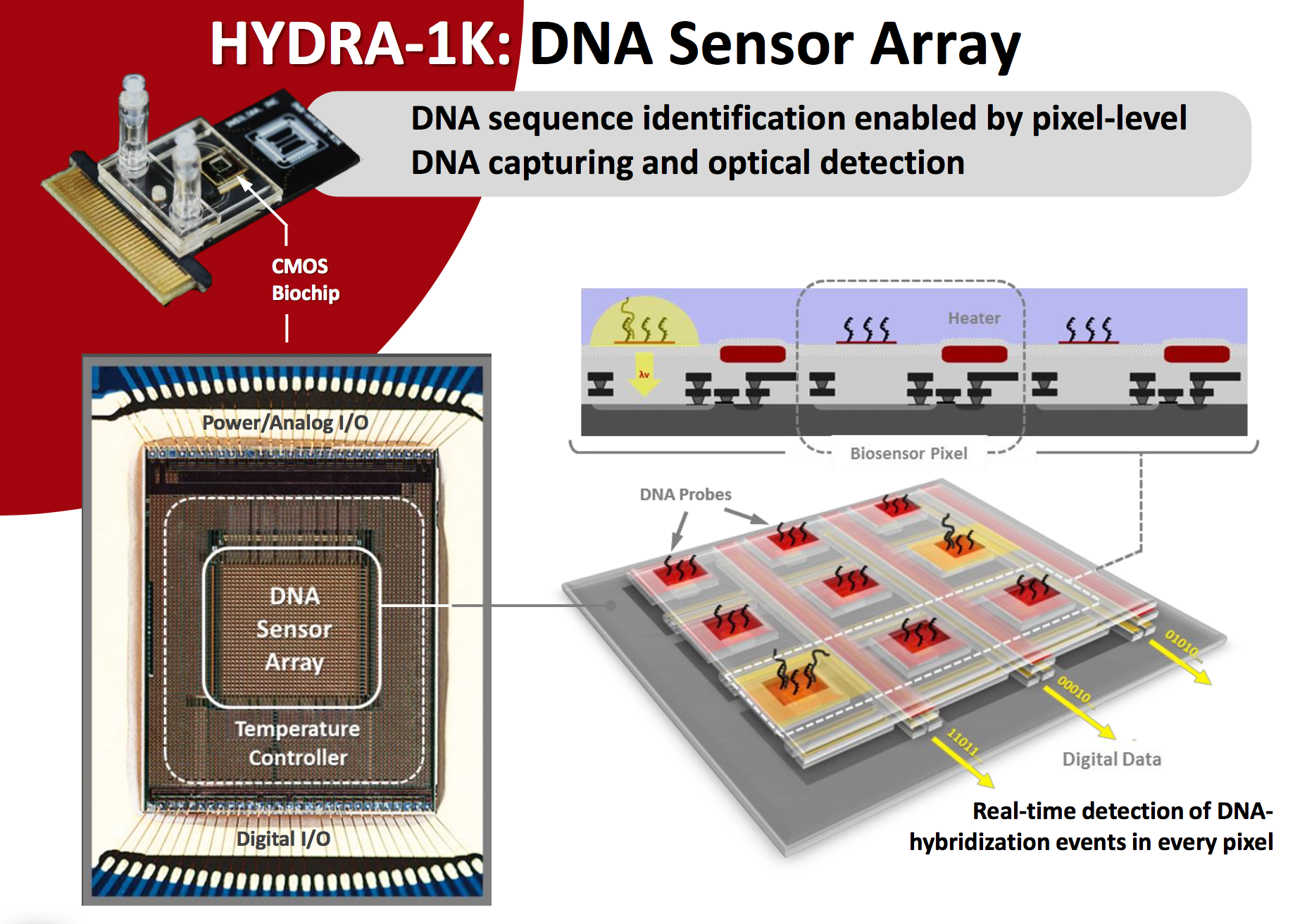
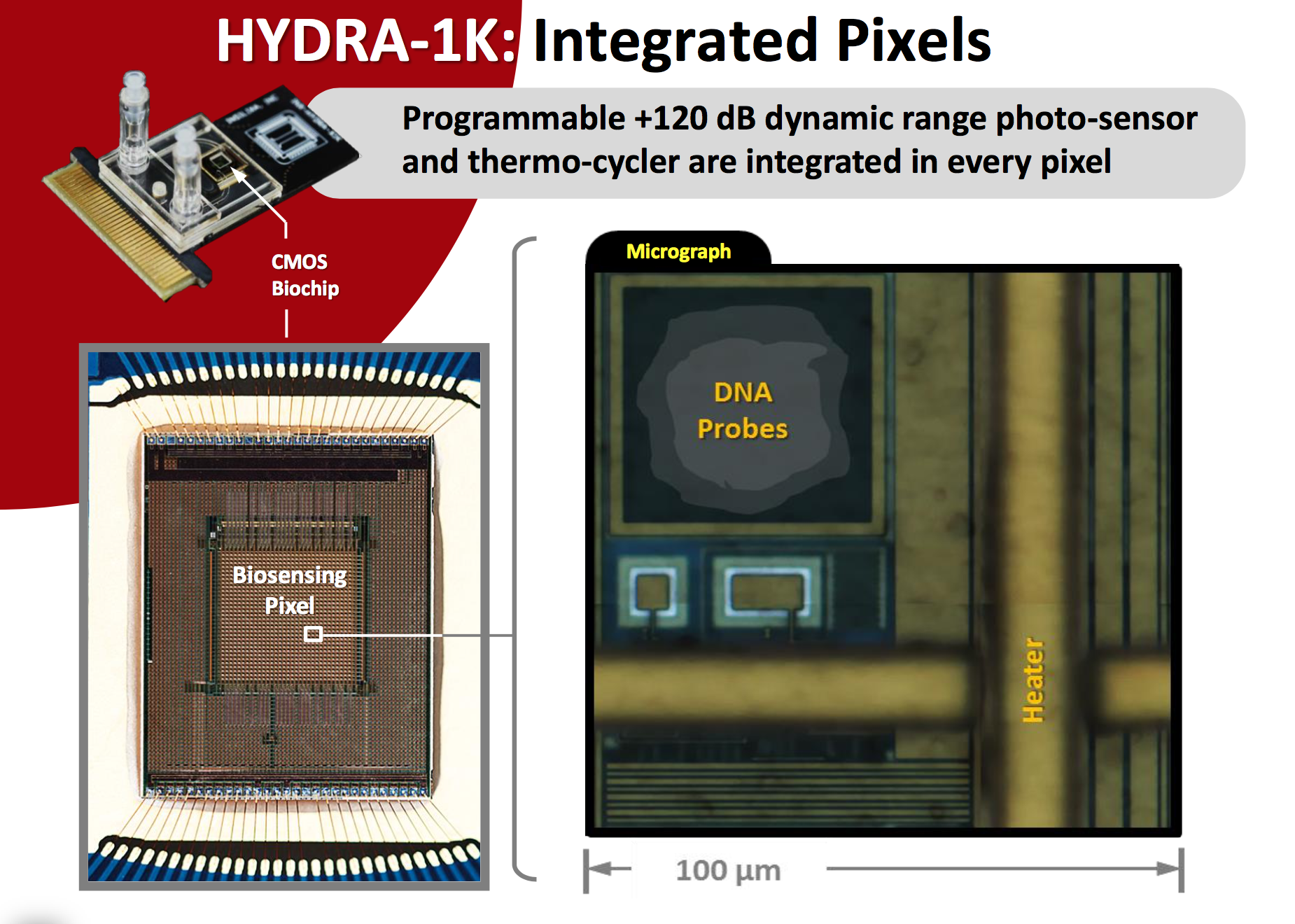
This presentation discusses a Hydra-1K chip, this is a 1008 sensor optical detection chip:

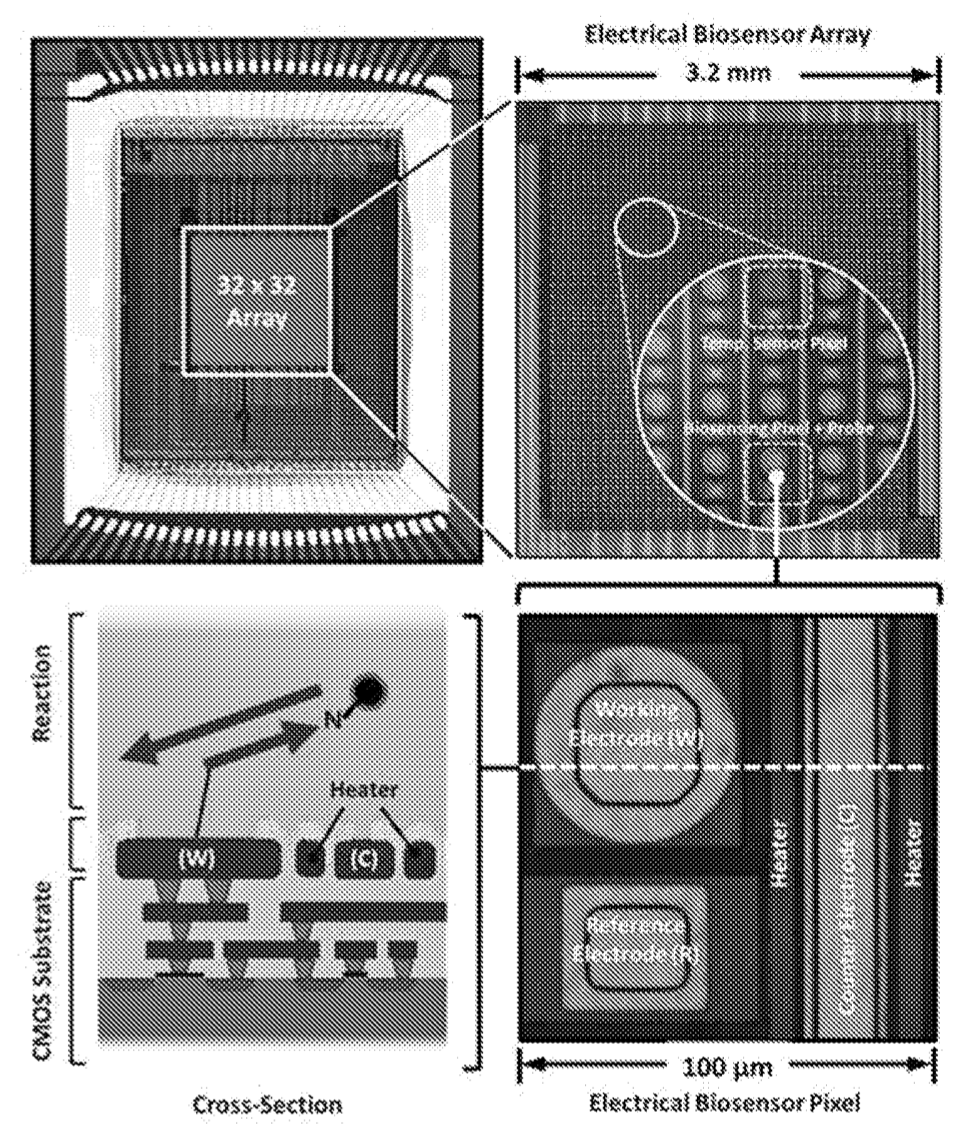
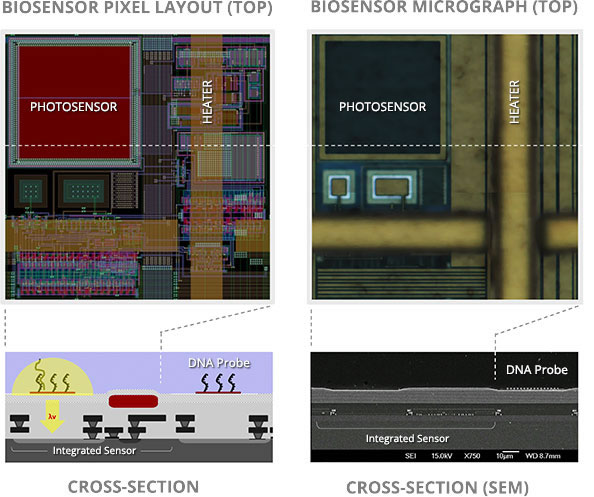
Probes are printed directly on top of sensors (printed, much like other array chips). Each sensor (photodiode) has a heater along side. This allows them to heat probes and melt them. As far as I can tell, this isn’t a TEC (Peltier) so there’s no ability to cool things back down. This seems somewhat limiting, in that the chips will start at room temperature, which may not be very well controlled.

The utility of embedding the heater on the chip isn’t so clear to me (as opposed to having a TEC attached to a jig which would mate onto the flow cell). Overall, I’m not clear that a similar device couldn’t be created by functionalizing a standard CMOS sensor… perhaps it’s related to the dynamic range required in the photodiodes.

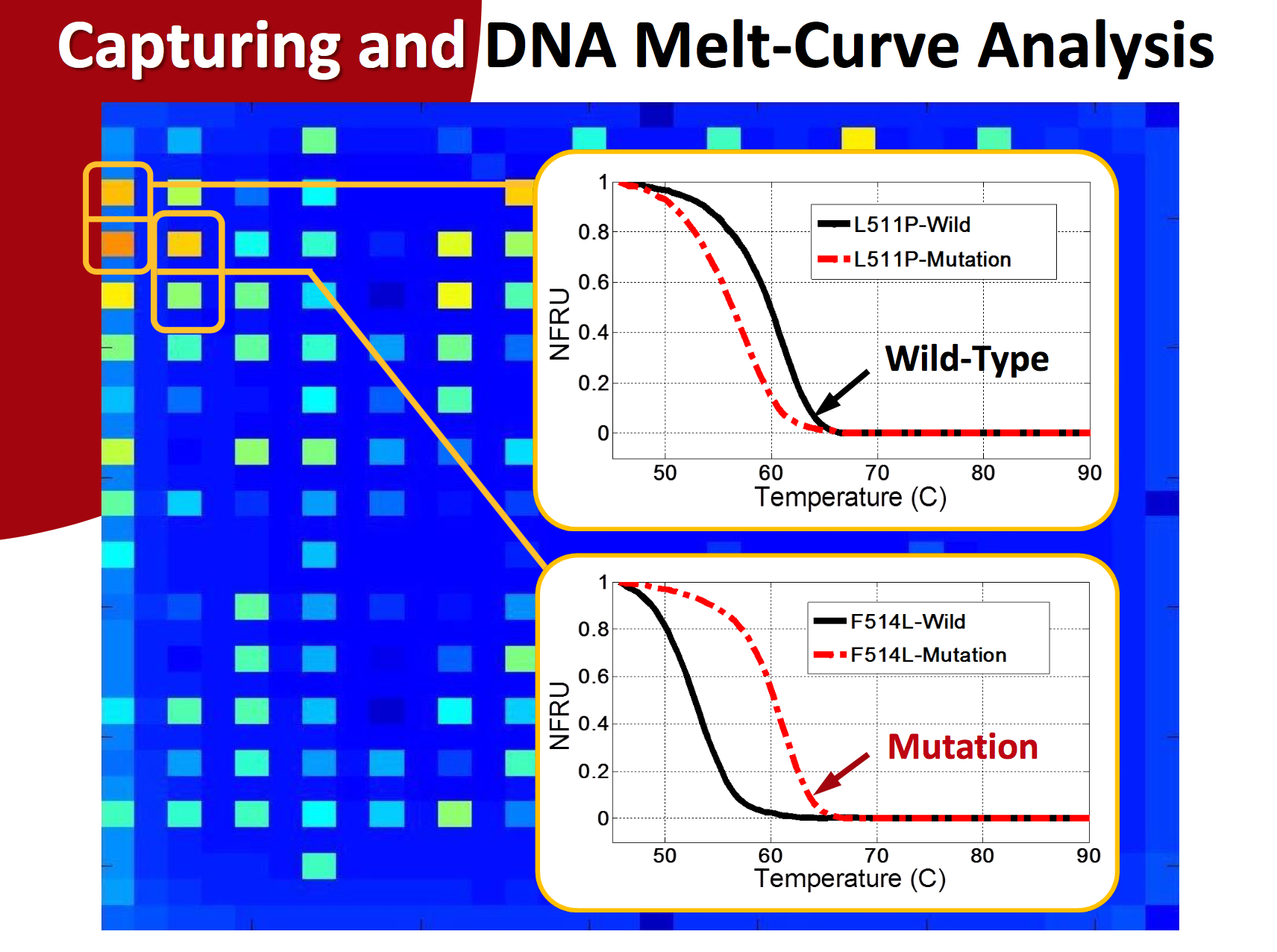
One of the problems with hybridisation is that it’s not very specific. To get more information out of process inSilixa monitor the melting process in real-time (much like real time/qPCR). They ramp the  temperature while monitoring the amount of fluorescence registered on the photodiode. This gives them a measurement of how much the DNA has melted, and allow them to generate a melting curve for each spot:

In most cases, I’d guess a mismatch should melt at a lower temperature and this should be visible on the curves.

So, that’s the system they appear to be focused on at the moment. However they also mention “ion-selective SAMs in sequence-by-synthesis arrays” on their website. That sounds pretty much like an ISFET approach, but it doesn’t look like it’s being actively explored. Bio-luminesence, voltammetry, and impedance measurements are also briefly mentioned, but there are few details on these approaches.

An interesting approach, clearly targeted at clinical diagnostics. Will be interesting to see if they make a move into sequencing in the future.


Notes

[1] https://www.crunchbase.com/organization/insilixa – 13MUSD. (2014)

[2] https://www.sbir.gov/sbirsearch/detail/412438

[3] http://www.freepatentsonline.com/WO2017155858A1.pdf

[4] https://www.hotchips.org/wp-content/uploads/hc_archives/hc26/HC26-11-day1-epub/HC26.11-3-Technology-epub/HC26.11.335-BioChip-Hassibi-InSilixa_08112014_FINAL.pdf

[5] https://www.youtube.com/watch?v=3icgDvXu1vA


iNanoBio

Today I picked another company from my list of active DNA sequencing companies, iNanoBio!

INanobio is a Arizona State University (ASU) spinoff company. As far as I can tell from SEC filing [1] they’ve raised about 500KUSD. SEC filings also indicate they they were looking to raise 4MUSD in 2017, but I couldn’t see evidence that this has closed.

Technology

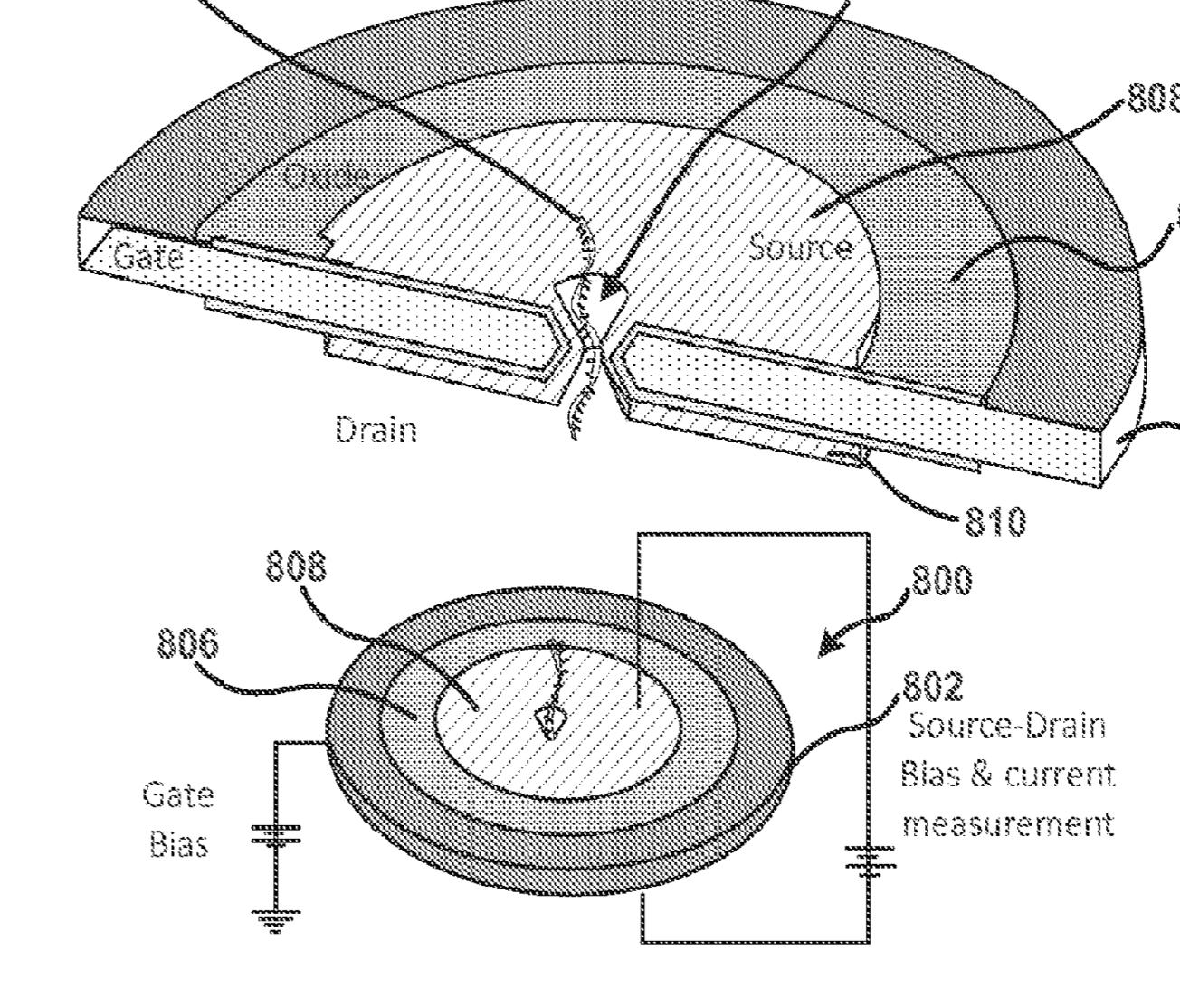
A significant challenge for nanopore sequencing is the speed at which DNA moves through the pore. One approach is to use enzymatic methods to slow the translocation of the DNA so it can more easily be read. iNanoBio is attempting to increase the read speed, so that they can sense DNA at 100Mhz to 1GHz as it passes through the pore.

As their patent [2] states, ionic mobility limits the rate you can measure changes in ionic current across a nanopore (they suggest ~10ms, which seems too slow, and don’t appear to provide a reference, if anyone has one I’d be most interested). They also suggest that tunnelling current measurement speed will be limited by quantum mechanical noise.

So instead of this they look at the base charges, specifically they say “dipole variations between individual bases”. The charges are detected by a novel FET transistor embedded in the nanopore. The nanopore has this sharp, conical shape. I assume this is designed to help avoid field contributions from multiple bases.

This sounds very neat, but I imagine generating the required signal level at >100MHz is challenging. It also feels like ensuring you only have charge contributions from a single (or small number) of basis would be problematic.

Never the less, if it works it’s a very neat idea. A 2014 youtube video suggests that they should be ready for research applications this or next year [3]… so I’ll keep an eye out!

Notes

[1] https://www.sec.gov/cgi-bin/browse-edgar?company=inanobio&owner=exclude&action=getcompany

[2] https://patents.google.com/patent/US20150060952A1

[3] https://www.youtube.com/watch?v=CwDdKhkQ-NE

QuantumDx

Building on from my list of sequencing companies in this post I look briefly at QuantumDX!

Business

QuantumDX Group was incorporated in March of 2008 [1]. In May 2009, they licensed nanowire FET IP, for use in DNA sequencing [2] from Nanosys. They also appear to have acquired a DNA testing service company (NorthGene limited).

November 2016, they received funding from Bill and Melinda gates foundation. Accounts state that they lost ~2.3MGBP in 2017, so their yearly burn rate seems to be about 3M GBP.

Their accounts state that they have operations in the UK, US and Singapore, and that commercialisation on a “research use only” basis is scheduled for 2018.

They raised 12MUSD [3] at the end of 2017. Given their previous burn, and cash in the accounts, my best guess would be that they’d have somewhere in the region of 10MUSD in the bank at present. Crunchbase lists them has having raise 26.3MUSD in total [4]. Investors include Barclays Global Investors and Helsinn Investment Fund SA.

QuantumDX also attempted to raise funds from Crowdfunding in 2014 [5], it appears at this point they had only raised from angel investors and grants.

Technology

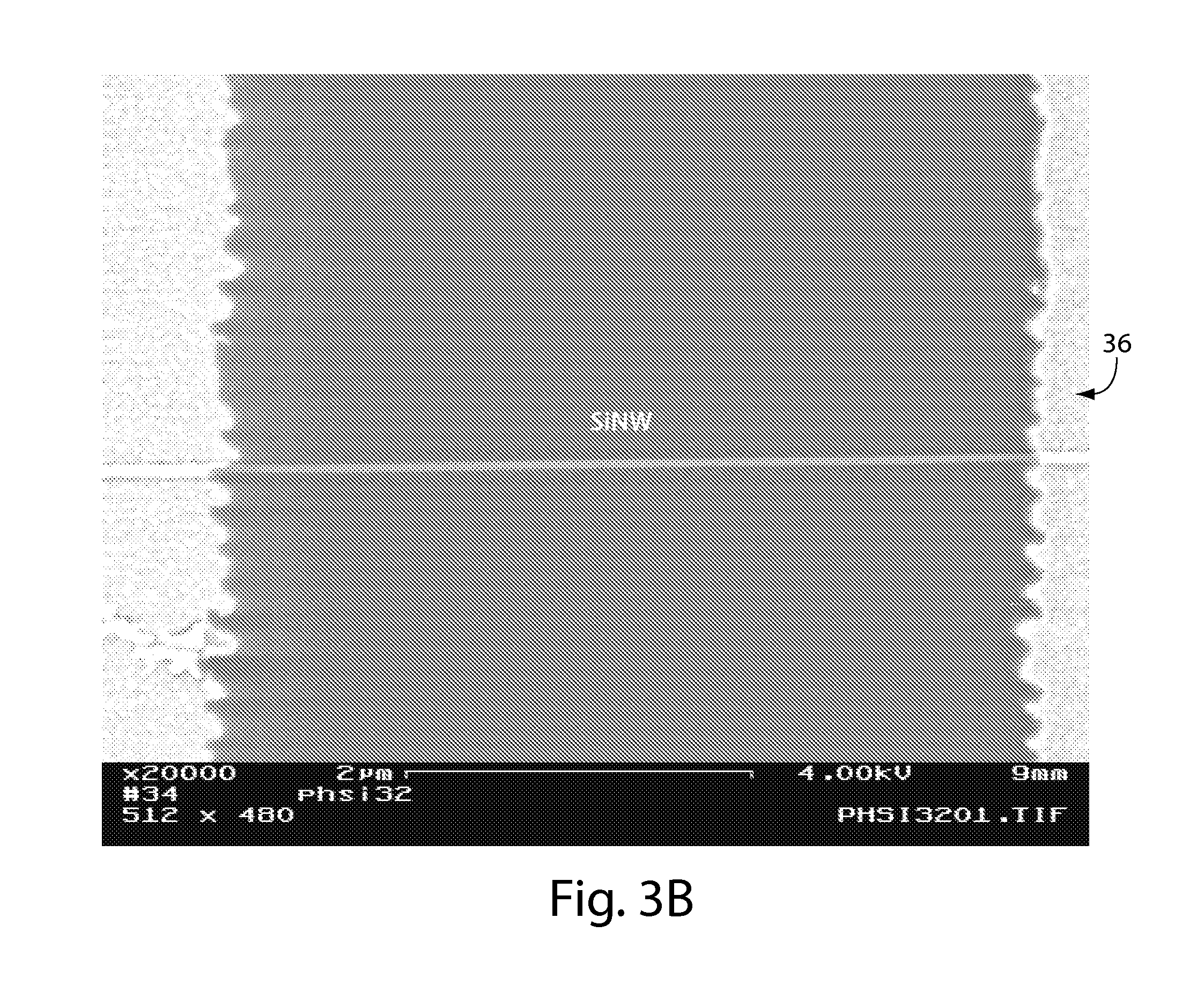
The QuantumDX technology appears to use FET nanowires for charge detection. The nanowire IP is licensed from Nanosys, while the QuantumDX patents don’t appear to show any SEM images of real structures, the Nanosys patents do [7] and are therefore a useful reference.

A number of structures are described in the patents, but the most relevant appear to be single nanowires stretched between electrodes (as I understand it, without doping and with no backing gate):

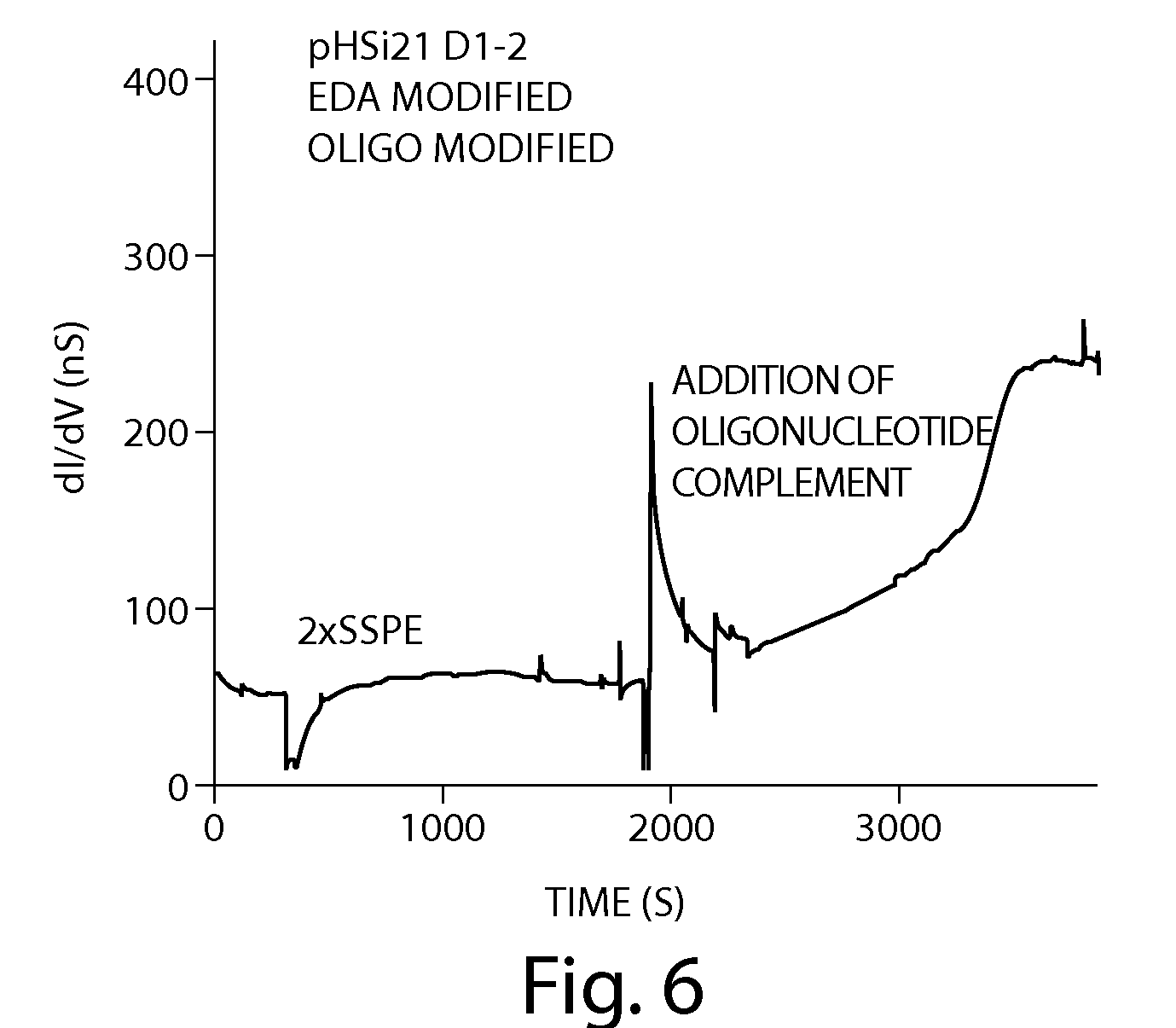
The patent also shows what appears to be real data of a nanowire complementary oligo hybridising to a probe on a nanowire:

From what I can tell, the presence of DNA (or any charged molecule) alters the resistivity of the nanowire. The nanowire contain very few charge carriers. This means that any nearby charges will have a significant effect on the flow or current through the nanowire. DNA being a charged molecule will effect the conductance of the nanowire, which is what you can see in the figure above.

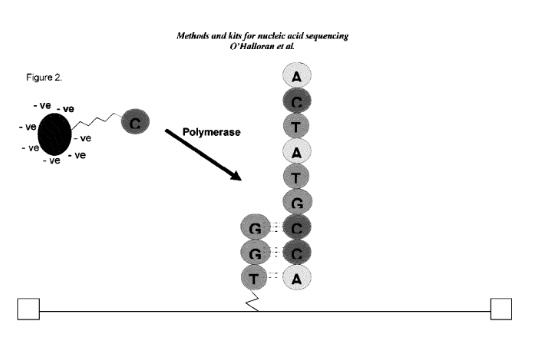
The QuantumDX patents describe a system that uses this effect to build a sequencing platform  (or potentially a probe based detection platform). The sequencing scheme appears to be standard sequencing-by-synthesis. Bases are added and incorporated into a template, and the increase in charge is detected. A number of patents refer to a “charge mass reporter moiety”. I guess detecting the single base charge may be problematic, so they can have a charged label attached to the bases to increase the amount of signal. I didn’t see anything that looked like real data in recent patents (but I’ve not looked very hard). A typical schematic of the system is shown below:

The system could obviously either be single molecule or work on clusters/amplified DNA. If the system could be made to work with single molecules (and ideally unlabelled nucleotides) I can see that it could be quite interesting, perhaps allowing quite long reads to be generated.

It’s an interesting approach, and I look forward to seeing more data as it appears.

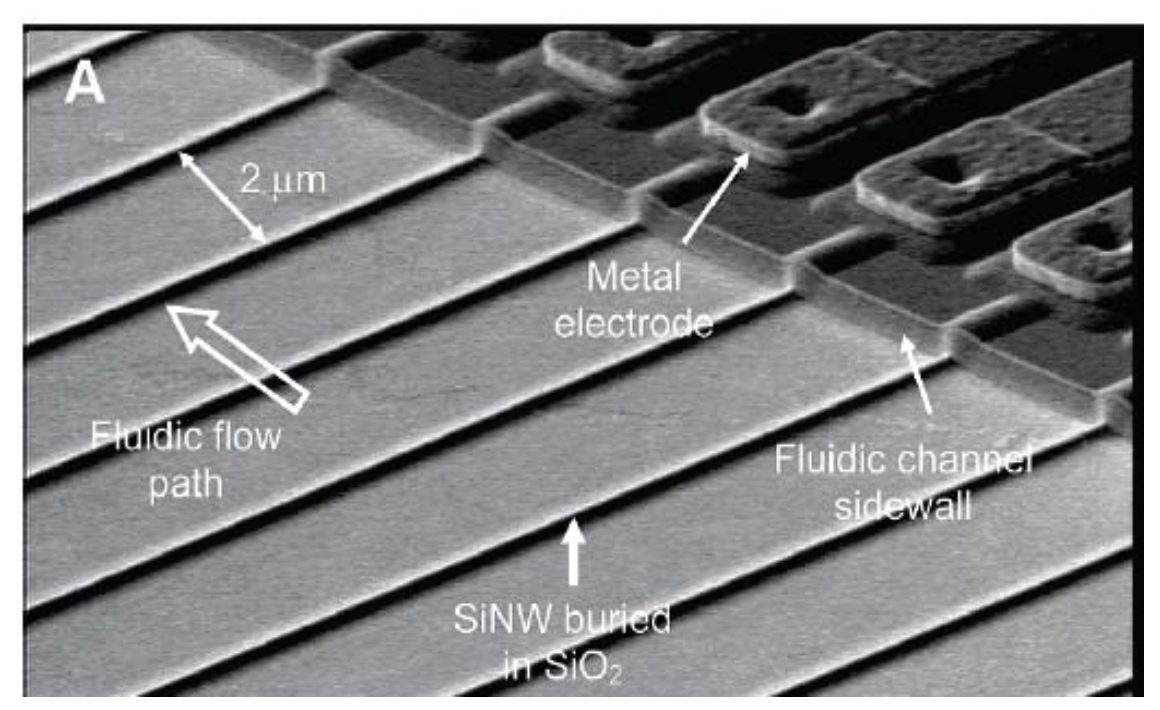
Update: this presentation and some nice figures, including the following SEM image:

Notes

[1] Companies House: https://beta.companieshouse.gov.uk/company/06523152 and https://beta.companieshouse.gov.uk/company/07067899

[2] “QuantuMDx Group (QMDx) today announced that QMDx has signed a non-exclusive license agreement with Nanosys for several patents and patent applications related to the use of nanowires for biosensors.

The core intellectual property involves the use of nanowire-based field effect transistors (FETs) as biosensors, which were derived from the work of Dr. Charles Lieber, a professor of chemistry at Harvard, a pioneer in nanotechnology, and one of the founders of Nanosys.

Under terms of the agreement, QMDx has secured worldwide rights for the use of nanowires for DNA sequencing and detecting biomarkers associated with disease. In exchange, Nanosys has received an upfront license fee and downstream royalty payments. No other financial details of the deal were disclosed.”

https://www.biospace.com/article/releases/nanosys-inc-licenses-nanowire-technology-to-quantumdx-group-for-next-generation-diagnostic-and-sequencing-technologies-/

[3] https://quantumdx.com/news/quantumdx-raises-12m-and-strengthens-board-as-company-eyes-commercialisation-of-q-poc-portable-mdx-platform

[4] https://www.crunchbase.com/organization/quantumdx-group#section-overview

[5] http://www.bio-itworld.com/2014/2/12/quantumdx-launches-moldx-indiegogo-campaign.html

[6] “The potential of nanowires was demonstrated in a 2001 Science paper authored by Harvard University’s Charles Lieber and colleagues. That proof of principle, according to Burn, showed that changes of impedance in silicon nanowires could record the arrival of a biomolecule. Recently, QMDx announced the exclusive license of intellectual property from Lieber’s company, Nanosys, of the diagnostic and sequencing applications of nanowires and nanotubes. (The arrangement succeeds a non-exclusive IP deal previously announced in 2009.)”

http://www.bio-itworld.com/issues/2012/jan/a-quantumdx-leap-for-handheld-dna-sequencing.html

[7] https://patents.google.com/patent/US20110315962A1

“FIG. 6 shows the conductance for a silico nanowire having a surface modified with an oligonucleotide agent reaction entity. The conductance changes dramatically where the complementary oligonucleotide analyte binds to the attached oligonucleotide agent.”