Illumina consumables are 90% profit?

I’ve heard a few people say that the reagent/consumables costs for Illumina are very low, and that the reagent/flowcell cost is <10% of the cost to the user. I wanted to try and find some facts to back this up. As far as I can tell the latest 10Q backs this up, and the gross margin for consumables is 90% (I would be very interested in other peoples thoughts however!).

I started by looking at the Illumina financial statements. I picked the Q1 2018 10Q from their site, and played around to see if I could estimate their consumable and instrument markup. Consumable and Instrument revenue is broken down, but not the costs.

Q1 2018 and Q1 2017 had similar instrument revenue (118M and 100M). Consumable revenue was up 99MUSD. Cost of product revenue (which I think is consumables+instruments) was up by 11MUSD (173M to 184M).

If we assume instrument revenue was at similar cost. Then the majority of the cost was due to consumable production. 11M in costs gave 99M in revenue. 88% gross margin.

Plugging this back in and trying to break out the instrument costs give 55.44M in reagent costs, and 118M in instrument costs.

In the 10Q instrument revenue is listed as 118MUSD. This seems like quite a coincidence, and would indicate that they sell instruments at zero profit. I wonder if they pile all instrument development costs into the instrument costs? From what I know of the cost of the various components, I expect the BOM cost to be much lower that the price Illumina sell instruments for.

I’d love other peoples thoughts on Illumina consumables, and instrument costs! If you have any, please get in touch (new at sgenomics dot org).

Evonetix and other thoughts

This post isn’t really about the Evonetix approach to DNA synthesis, but rather about related ideas. To set the context, I review an approach described in one of their older patents (their current approach pretty well on their website).

Evonetix was incorporated in February 2015 (Cambridge, UK). They have raised somewhere of the order of ~15MUSD to date. Investors include Cambridge Consultants, Hermann Hauser, DCVC, Draper Esprit, Morningside Group, Rising Tide, and Civilization Ventures.

Their patents [1] describe the basic approach, their patents seem quite readable and I recommend taking a look.

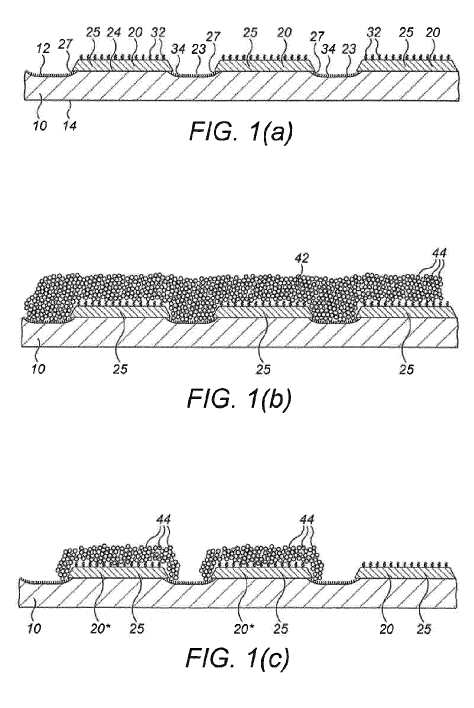
Essentially, they describe using a substrate on which sites are coated with a waxy layer (it seems n-Alkane is preferred). They then selectively melt the wax in order to expose the substrate to reagents. They don’t mentioned enzymatic DNA synthesis methods in the patents I’ve read at all. It looks like phosphoramidite synthesis is the focus.

They discuss two approaches to applying heat, either using a laser or via on chip heating elements. Given their recent deal with LioniX [4] it seems likely that they will continue down the silicon based route. As usual a number of configurations are discussed in the patent, but in particular a 0.5 micron spacing is mentioned. In the patent and elsewhere a billion wells seems to be the target. This would result in something like a ~16mm^2 chip. Big enough that I’d hope it would be reusable, but not massive.

I would guess one of the issues would be insuring that the thermal changes are sufficiently localized. The patent suggests a couple of methods [2] [3] to help with this, but I imagine it will be a significant challenge. In fact, you also want to uniformly cool the chip after each cycle as well… so all round accurate thermal control will be the important.

Thoughts

Essentially the Evonetix play is around designing a system to selectively expose a “virtual well” to reagents. That’s quite an interesting idea, but it made me wonder about related approaches.

Activating Enzymes

The first thought that occurs to me is that how might a similar system be used in an enzymatic DNA synthesis platform. Rather than using heating elements to expose a strand under extension to reagents could you use heat to either activate or deactivate enzymes.

For example lets say you cool the whole chip down, to a point where the template independent polymerase (TdT) is largely inactive. You then locally heat the chip, only where you want incorporation to take place (which would occur cyclicly).

Confining the heat in the presence of reagents might be more of an issue here.

Using an electric field

Rather than deactivating the polymerase thermally, could you alter the local conditions around a strand under synthesis using an electric field. Initially I was wondering if a negative field would, kind of push away nucleosides. However, it seems [5] that a field can also be used to locally change the pH. Could you therefore use local changes in pH to activate/deactivate an enzyme?

Non-virtual wells

The Evonetix play is around the use of a “virtual well”. But how might you go about creating real wells with caps which could easily be opened and closed to selectively expose the contents of the well to reagents?

One approach might be to use a larger (maybe 500nm?) bead as a cap. The bead could be magnetic, or charged. In those cases, you could use a magnetic or electric field to selectively push the bead away from the well just enough to allow reagents to enter the well. You might want to coat the well with something to help create a seal perhaps.

Local heating could also be used to push the bead off the well perhaps, or other methods like optical tweezers… these seem less attractive however.

Those were my initial thoughts anyway… Evonetix seem like an interesting company, and I look forward to seeing how things develop.

Notes

[1] https://patents.google.com/patent/US20160184788A1/en US20160184788A1

[2] “To achieve a great melting and coalescence of the masking material within a limited area, a series of discrete heating pulses may be used, each pulse being separated by period of cooling. For example, a series of 1,000-20,000…heating pulses… about 1 ns… with about 1 microsecond of cooling between each pulse may be suitable.”

[3] “The thermal energy may be applied to the selected ones of the sites simultaneously, but alternatively it may be desired to stagger the application of thermal energy to the select sites in order to allow for more efficient diffusion of thermal energy away from a selected site following the application of thermal energy. Suitably, the application of thermal energy to the selected site is carried out so that the adjacent sites are not heated simultaneously and optionally not immediately one after another.”

[4] https://www.evonetix.com/evonetix-lionix/

[5] https://patents.google.com/patent/US20130344539

An Encoding And Correction Approach for DNA Data Storage

I’ve previously noted that there’s significant interest in using DNA as a data storage medium. In my previous post, I discussed a correction/selective amplification approach which might help remove errors in errored synthesis platforms.

In this post I consider an encoding and selective amplification approach that might work particularly well for DNA data storage.

In this approach only a subset of bases are used to encode information. Other bases are used to provide synchronisation points.

For example we might use the bases A,T, and C to encode information. G would be used as a synchronisation base. We might for example, have 9 bases of information followed by a synchronisation “G” [1].

We can see how this could work by way of the following example:

True sequence:
0123456789012345678901234567890123456789
TACTACTATCGTCATCATCTGCTAATCATTGACTTTACTA

Our synchronisation “G”s will allow us to selectively amplify those synthesized strands matching the “true” (desired) sequence which do not contain insertion errors.

For example, the following strand contains an error at position 7. We would use the technique previously described, that is we would use a normal polymerase and perform stepwise incorporation by flowing in bases in the “true”/desired order.

Error at position 7:
01234567890123456789012345678901234567890
TACTACTCATCGTCATCATCTGCTAATCATTGACTTTACTA
ATGATGAGTAGCAGTAGTA

The presence of regular synchronisation “G”s makes it harder for an errored strand to advance when undergoing stepwise synthesis, as the strand needs to wait for up to 9 bases to flow through the system until it can start to advance when out of sync.

As previously noted, this scheme can be used to selectively amplify strands without insertion errors (between rounds of melting). The amplification scheme could be applied at regular intervals to remove error’d strands from the system.

This amplification scheme does not help with deletion errors, these as possibly less critical here as they appear as a length error (which may be illuminated though size selection). The most critical errors maybe a combination of insertions and deletions which result in strands of the same length as our desired strand. This scheme could help remove these.

Notes

[1] Naturally, different bases, and different spacing could be used. Potentially you might want to switch between using different sets of bases to encode information, and for synchronisation throughout a strand.

The encoding used, could be one of a number of schemes. Of particular interest might be an encoding that minimises the impact of deletion errors with respect to the desired sequence (for example, uses longer homopolymers to encode data).

Using an SBS-like approach to selectively amplify

Today I was pondering that fact that there are DNA synthesis approaches that may result in high error rates.

One significant class of errors is insertions. In particular, homopolymer errors. One of the issues with enzymatic DNA synthesis is that so far, it’s been difficult to incorporate bases with reversible terminators.

One approach could be to limit the number of bases incorporated purely through the concentration present. This is likely to result in a highly errored product however. Even if your error rate is 5%, after incorporating 100 bases, less than 5% of your product will be fully correct.

If we could selectively amplify only the correct strands, this might give us more utility out of an inefficient/errored synthesis platform.

Let’s say we get some reasonable fraction of fully correct strands at 20 bases [1]. Size selection might be problematic [2] as many errors will be either the same length, or nearly the same length. We assume that insertion errors dominate, and it’s these errors that we’re mostly interested in removing.

One approach might be to selectively completely amplify only those strands which don’t contain insertions. You can do this, by step-wise synthesis of a complementary strand. By exposing the strand to reversibly terminated [3] bases in the correct order only. The scheme is somewhat similar to sequencing-by-synthesis, but here is used for selective amplification.

To take an example, say we have attempted to synthesize the sequence CGTCCCTAGTCGACTGACGT. We would expose the synthesized strands to complementary bases in the correct order [4] during stepwise synthesis. This stepwise process would be, similar to sequencing-by-synthesis (incorporate, wash/remove, cleave terminators etc.).

A fully correct strand, or one containing deletions only will incorporate a base at every position. A complete complementary strand will therefore be created.

A strand with an insertion however will become out of sync with the correct/desired bases. It will therefore no incorporate a base at every position.

In the example below, we can see how a single insertion error, will result in a strand half the size of the original. Insertion errors are therefore converted to larger fragment size errors (and produce significantly smaller fragments in many cases).

In this example bases are flowed into the pool in the order G,C,A,G etc. and incorporated from the 3′ end of the template.

In the errored strand, bases incorporate correctly until the 6th position. At this point, the synthesis process gets out of sync. An A,T,C, and A fail to incorporate, before another G is encountered. The final synthesised strand is ~50% smaller than the fully correct template.

True sequence
   01234567890123456789
3' CGTCCCTAGTCGACTGACGT 5'
5' GCAGGGATCAGCTGACTGCA 3'

Insertion
   012345678901234567890
3' CGTCCCCTAGTCGACTGACGT 5'
5' GCAGGGGATCA           3'

The process described would most likely need to be performed cyclicly (between rounds of melting), to amplify the pool of strands sufficiently. After this selective amplification process, size selection [6] could take place to select the correct (or a “more correct” subset). This subset might be used for downstream applications, or as a substrate for further synthesis [5].

This amplification process might remove the most problematic errored strands from the synthesis process [6] as well as potentially allowing us to gain more utility for an errored synthesis process.

Notes

[1] I’m selecting 20 bases to keep the examples simple.

[2] Again size selection of short fragments is problematic anyway, but this is just an example.

[3] Or maybe, without terminators if you don’t care so much about homopolymer errors and only interested in removing other insertions.

[4] Appropriated primed+a normal polymerase, suitable for incorporating the base we are using.

[5] Effectively you might try and “reset” the synthesis process periodically, by removing errors from the pool.

[6] The most problematic errored strands might be those that are the same size as the fully correct template. These strands would need to be the result of at least an insertion and a deletion. The above scheme will not completely amplify these strands, and could therefore help mitigate against this issue.