March 23, 2012, 11:24 pm
Some more rough and ready algorithm code, non-OO C++. Pretty bad code, not well tested, just playing.
#include <iostream>
#include <vector>
#include <stdlib.h>
#include <algorithm>

using namespace std;


class Node {

public:

  Node() {
  }

  vector<Node *> children;
  Node *parent;
};

Node *make_random_tree(size_t size,Node *root=NULL) {

  if(root == NULL) {
    root = new Node();
  }

  Node *current = root;

  size_t children=rand()%size;
  for(size_t i=0;i<children;i++) {
    Node *nd = new Node();
    nd->parent = current;
    current->children.push_back(nd);
  }

  for(size_t n=0;n<current->children.size();n++) {
    make_random_tree(size-children,current->children[n]);
  }

  return root;
}

Node *get_random(Node *root,size_t avg_size) {

  Node *current = root;
  for(;rand()%(avg_size*2) != 0;) {
    if(current->children.size() == 0) return current;

    current = current->children[rand()%current->children.size()];
  }

  return current;
}

Node * get_next_child(Node *node,Node *child) {

  bool next=false;
  for(size_t n=0;n<node->children.size();n++) {

    if(next==true) {
      return node->children[n];
    }

    if(node->children[n] == child) next=true;
  }

  return NULL;
}

vector<Node *> get_path(Node *root,Node *n) {

  vector<Node *> current_path;
  current_path.push_back(root);

  if(n==root) return current_path;

  Node *current_child = root->children[0];

  for(;;) {

    current_path.push_back(current_child);
    if(current_child == n) return current_path;

    if(current_child->children.size() != 0) {
      current_path.push_back(current_child->children[0]);
      current_child = current_child->children[0];
    } else {
      current_child = NULL;
      for(;current_child == NULL;) {
        Node *old_child = current_path[current_path.size()-1];
        current_path.erase(current_path.begin()+current_path.size()-1,current_path.end());
        current_child = get_next_child(current_path[current_path.size()-1],old_child);

        if(old_child==root) { return vector<Node *>(); }
      }
    }
  }

  // Should never get here
  return vector<Node *>();
}

vector<Node *> get_path_parent(Node *root,Node *n) {

  vector<Node *> v;

  for(Node *current = n;current != root;current = current->parent) {
    v.push_back(current);
  }
  v.push_back(root);

  reverse(v.begin(),v.end());

  return v;
}

Node *find_lca_parent(Node *root,Node *n1,Node *n2) {

  vector<Node *> path1 = get_path_parent(root,n1);
  vector<Node *> path2 = get_path_parent(root,n2);

  for(size_t n=0;n<path1.size();n++) {cout << path1[n] << " ";} cout << endl;
  for(size_t n=0;n<path2.size();n++) {cout << path2[n] << " ";} cout << endl;

  size_t shortest_path_length;
  if(path1.size() < path2.size()) shortest_path_length = path1.size();
                             else shortest_path_length = path2.size();

  size_t n;
  for(n=0;(n<shortest_path_length) && (path1[n] == path2[n]);n++);

  return path1[n-1];
}

Node *find_lca(Node *root,Node *n1,Node *n2) {

  vector<Node *> path1 = get_path(root,n1);
  vector<Node *> path2 = get_path(root,n2);

  size_t shortest_path_length;
  if(path1.size() < path2.size()) shortest_path_length = path1.size();
                             else shortest_path_length = path2.size();

  size_t n;
  for(n=0;(n<shortest_path_length) && (path1[n] == path2[n]);n++);

  return path1[n-1];
}

int main() {

  Node *root = make_random_tree(100);

  Node *n1 = get_random(root,20);
  Node *n2 = get_random(root,20);

  Node *lca1a = find_lca_parent(root,n1,n2);
  Node *lca1b = find_lca       (root,n1,n2);

  cout << "LCA1-a: " << lca1a << endl;
  cout << "LCA1-b: " << lca1a << endl;

  Node *n3 = root->children[0]->children[0]->children[0];
  Node *n4 = root->children[0]->children[0]->children[1];
  Node *lca2a = find_lca_parent(root,n3,n4);
  Node *lca2b = find_lca       (root,n3,n4);

  cout << "LCA2-a: " << lca2a << endl;
  cout << "LCA2-b: " << lca2b << endl;
}
March 20, 2012, 4:42 pm
This is a simple, inefficient implementation of the Burrows-Wheeler transform in C++. I wrote it just to play around with the algorithm, not for any practical application. It takes a single text file as the input, then performs the transform and reverses it:
#include <iostream>
#include <fstream>
#include <string>
#include <vector>

using namespace std;

void bwt(string input,string &bwt_str,int &primaryidx) {

  vector<string> rotations;

  // 1. generate rotations of input
  cout << "rotations:" << endl;
  for(int n=0;n<input.size();n++) {
    string s;

    s += input[n];
    for(int i=n+1;i!=n;i++) {
      if(i==input.size()) i=0;
      s += input[i];
      if(i==input.size()-1) i=-1;
    }
    rotations.push_back(s);
    cout << s << endl;
  }

  // 2. sort
  cout << "sorted:" << endl;
  sort(rotations.begin(),rotations.end());
  for(size_t n=0;n<rotations.size();n++) {
    cout << rotations[n] << endl;
  }

  bwt_str.clear();
  for(size_t n=0;n<rotations.size();n++) {
    bwt_str += rotations[n].substr(rotations[n].size()-1,1);
    if(rotations[n] == input) {primaryidx = n;}
  }
  cout << "bwt string: " << bwt_str << endl;
  cout << "primaryidx: " << primaryidx << endl;
}

string rbwt(string bwt_str,int primaryidx) {

  vector<string> cur_str;

  for(size_t n=0;n<bwt_str.size();n++) {
    string s;
    s = bwt_str.substr(n,1);
    cur_str.push_back(s);
  }

  for(;cur_str[0].size() < bwt_str.size();) {
    vector<string> new_str = cur_str;
    sort(new_str.begin(),new_str.end());

    for(size_t n=0;n<cur_str.size();n++) {
      cur_str[n] = cur_str[n] + new_str[n].substr(new_str[n].size()-1,1);
    }
  }

  cout << "reversed transform:" << endl;
  for(size_t n=0;n<cur_str.size();n++) {
    cout << cur_str[n] << endl;
  }

  sort(cur_str.begin(),cur_str.end());

  cout << "Original String: " << cur_str[primaryidx] << endl;

  return cur_str[primaryidx];

}

int main(int argc,char **argv) {

  string s;

  ifstream infile(argv[1]);

  for(;!infile.eof();) {
    char c = (char)infile.get();

    if(!infile.eof()) s += string(1,c);
  }
  cout << "input: " << s << "END" << endl;

  string bwt_str;
  int primaryidx;

  bwt(s,bwt_str,primaryidx);

  rbwt(bwt_str,primaryidx);
}
March 20, 2012, 10:24 am
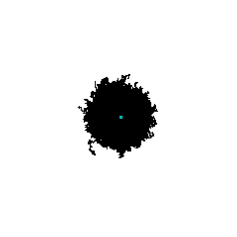
Some quick Javascript which plots random walks from a point…
View it here.
<html>
<head>

<script type="text/javascript">

  var ittr=8;
  var delta=-0.005;

  function draw_frame() {
    var canvas = document.getElementById("m_canvas");
    if(canvas.getContext) {
      var ctx = canvas.getContext("2d");
      ctx.lineWidth  = 0;
      ctx.fillStyle = "rgb(0,0,0)";


      var x=250;
      var y=250;
      for(var n=0;n<200;n++) {
        var r=Math.floor(Math.random()*4);
        if(r==0) { x+=1; y+=0; }
        if(r==1) { x+=0; y+=1; }
        if(r==2) { x-=1; y+=0; }
        if(r==3) { x-=0; y-=1; }
        ctx.fillRect(x*1,y*1,1,1);
      }

      ctx.fillStyle = "rgb(0,200,200)";
      ctx.fillRect(250,250,3,3);
    }
  }

</script>

</head>

<body  onload="setInterval(draw_frame,10);" >
<canvas id="m_canvas" width="500" height="500">You need a Javascipt</canvas>

</body>

</html>
March 18, 2012, 2:55 pm
Another quick and dirty algorithm implementation in C++. This time a Binary search tree (no balancing):
#include <iostream>
#include <vector>

using namespace std;

class Node {

public:

  int value;

  Node *less;
  Node *more;
};

class BinarySearchTree {

public:

  BinarySearchTree() : root(NULL) {}

  void find_node(int value,Node **findnode,Node **parent) {

    *findnode = NULL;
    *parent   = NULL;

    if(root == NULL) {
      return;
    }

    Node *current = root;
    for(;;) {
      if(current->value == value) {*findnode = current; return;}

      if(value < current->value) {
        if(current->less != NULL) {*parent = current; current = current->less;}
        else {
          return;
        }
      } else {
        if(current->more != NULL) {*parent = current; current = current->more;}
        else {
          return;
        }
      }
    }
  }

  Node *getr(Node *c,Node **parent) {
    *parent = c;
    for(;c->more != NULL;) {
      *parent = c;
      c = c->more;
    }
    return c;
  }

  void remove(int value) {

    Node *delnode;
    Node *parent;

    find_node(value,&delnode,&parent);

    if(delnode == NULL) return;

    // leaf
    if((delnode->less == NULL) && (delnode->more == NULL)) {
      if(parent->less == delnode) {parent->less = NULL;}
      if(parent->more == delnode) {parent->more = NULL;}
      delete delnode;
      return;
    }

    // only one child
    if((delnode->less == NULL) || (delnode->more == NULL)) {
      if(delnode->less != NULL) {
        if(parent->less == delnode) {parent->less = delnode->less;}
        if(parent->more == delnode) {parent->more = delnode->less;}
        delete delnode;
        return;
      }

      if(delnode->more != NULL) {
        if(parent->less == delnode) {parent->less = delnode->more;}
        if(parent->more == delnode) {parent->more = delnode->more;}
        delete delnode;
        return;
      }
    }

    // two children
    Node *i = getr(delnode->less,&parent);

    delnode->value = i->value;
    if(parent == i)       { delnode->less = NULL;}
    if(parent->less == i) { parent->less = NULL; }
                     else { parent->more = NULL; }
    delete i;
  }

  void insert(int value) {

    if(root == NULL) {
      Node *n = new Node();
      n->value = value;
      n->less = NULL;
      n->more = NULL;
      root = n;

      return;
    }

    Node *current = root;
    for(;;) {
      if(value < current->value) {
        if(current->less != NULL) current = current->less;
        else {
          Node *n = new Node();
          n->value = value;
          n->less = NULL;
          n->more = NULL;
          current->less = n;
          break;
        }
      } else {
        if(current->more != NULL) current = current->more;
        else {
          Node *n = new Node();
          n->value = value;
          n->less = NULL;
          n->more = NULL;
          current->more = n;
          break;
        }
      }
    }
  }

  bool exists(int value) {
    if(root == NULL) {
      return false;
    }

    Node *current = root;
    for(;;) {
      if(current->value == value) return true;

      if(value < current->value) {
        if(current->less != NULL) current = current->less;
        else {
          return false;
        }
      } else {
        if(current->more != NULL) current = current->more;
        else {
          return false;
        }
      }
    }
  }

  Node *root;
};

int main() {

  BinarySearchTree s;

  vector<int> testdata;

  for(size_t n=0;n<10;n++) { testdata.push_back(rand()%20); }

  for(size_t n=0;n<10;n++) { s.insert(testdata[n]); }

  cout << "testdata: " << endl;
  for(size_t n=0;n<10;n++) { cout << testdata[n] << endl; }

  cout << "existance check: " << endl;
  for(size_t n=0;n<10;n++) { if(s.exists(testdata[n])) cout << "existance: " << testdata[n] << " true" << endl; else cout << "existance: " << testdata[n] << " false" << endl;}
  for(size_t n=0;n<10;n++) { if(s.exists(testdata[n]+20)) cout << "existance: " << testdata[n]+20 << " true" << endl; else cout << "existance: " << testdata[n]+20 << " false" << endl;}

  cout << "remove: " << testdata[5] << endl;
  s.remove(testdata[5]);
  if(s.exists(testdata[5])) cout << testdata[5] << " still exists" << endl; else cout << testdata[5] << " no longer exists" << endl;

  cout << "remove: " << testdata[3] << endl;
  s.remove(testdata[3]);
  if(s.exists(testdata[3])) cout << testdata[3] << " still exists" << endl; else cout << testdata[3] << " no longer exists" << endl;

  cout << "remove: " << testdata[0] << endl;
  s.remove(testdata[0]);
  if(s.exists(testdata[0])) cout << testdata[0] << " still exists" << endl; else cout << testdata[0] << " no longer exists" << endl;
}
 RSS
RSS